My Tretinoin Skincare Routine at 38: How I Use It Without Wrecking My Skin Barrier
This post may contain affiliate links, which means I may earn a small commission if you make a purchase through my links at no additional cost to you. I only share products I personally use or genuinely recommend.
I started tretinoin because I’m 38 and, lately, when I look in the mirror… ugh. 😂
Wrinkles. Uneven texture. Dullness. All those little changes that apparently decided it was time to show up at once.
I’d already been using over-the-counter skincare products consistently for a couple of years, and honestly, the difference in my skin’s hydration has been amazing. My skin is naturally dry, so finding products that actually keep it feeling hydrated was a huge win.
But I wanted something that went a little deeper.
I wasn’t just looking for another moisturizer that made my skin feel good for the day. I wanted to get more serious about the appearance of fine lines, uneven skin tone and texture.
And I kept hearing about tretinoin.
So, after seeing it over and over again, I finally decided to talk to my doctor and see if it might be a good option for me.
My doctor agreed and prescribed it.
I was excited.
Maybe a little too excited.
Because within the first couple of weeks, I managed to learn one of the most important lessons about tretinoin the hard way:
More is NOT better.
And my skin made sure I understood that. 😂
After a lot of trial and error, this is the tretinoin skincare routine I’ve landed on — one that lets me use tretinoin while putting just as much emphasis on hydration and protecting my skin barrier.
Why I Started Using Tretinoin at 38
I’ve spent the last couple of years really getting into skincare.
What started as trying to fix my ridiculously dry skin eventually turned into learning about ingredients, hydration, skin barrier support, devices, serums, masks…and approximately 7,492 skincare products online. 😂
And I’ve found some products that I genuinely love.
If dry skin is one of your struggles too, I shared my everyday products and exactly how I use them in my Dry Skin Skincare Routine.
But as I got closer to 40, I started paying more attention to things that hydration alone wasn’t necessarily going to address.
Fine lines.
Texture.
Uneven-looking skin.
Those little changes where you’re not exactly sure when they happened…but suddenly you’re staring at them in the bathroom mirror. 😂
That’s ultimately what led me to ask my doctor about tretinoin.
My First Tretinoin Mistake: Doing Too Much, Too Soon
When I first got my prescription, I was ready to GO.
I had heard all these amazing things about tretinoin, and apparently my brain translated that into:
If some tretinoin is good, surely MORE tretinoin FASTER is even better.
Spoiler alert:
It wasn’t. 😂
I went too hard, too fast.
Within the first couple of weeks, my skin became incredibly irritated. I ended up with what I would describe as tretinoin burn, and my skin barrier was not happy.
So instead of getting the smooth, glowy skin I had envisioned…
I was now trying to repair the damage I’d done while trying to make my skin look better.
Not exactly the plan.
I stopped tretinoin completely for a few weeks and focused on getting my skin feeling comfortable again.
And during that time?
I researched.
And researched.
And researched some more.
There is SOOOOO much information about tretinoin online.
And just as many skincare products people tell you that you absolutely need while using it.
It gets overwhelming FAST.
But the biggest thing I learned from all that research was actually pretty simple:
Keeping my skin barrier healthy needed to be priority #1.
I didn’t need 15 new actives.
I didn’t need to use tretinoin every possible night.
And I definitely didn’t need to attack my skin into looking younger. 😂
I needed to slow down and listen to my skin.
Starting Tretinoin Again—But Differently
Once my skin felt completely back to normal, I decided I was ready to try again.
But this time, I wasn’t going to destroy my skin while trying to make it look younger.
Low and slow became the game.
I currently use my prescription tretinoin around 2–3 nights per week, depending on how my skin is feeling.
And that’s an important part of it.
If it’s technically a “tretinoin night” but my skin feels dry, irritated or just off?
I don’t use it.
My calendar doesn’t get to decide what my skin can handle that night.
My skin does.
I also discovered something that has made a huge difference for my dry, sensitive skin:
The tretinoin sandwich method.
I’ll show you exactly how I do it below.
My Current Tretinoin Skincare Routine
One thing you’ll notice is that my nighttime routine isn’t exactly the same every night.
That’s intentional.
Instead of trying to squeeze every active ingredient and skincare product I own into one routine, I rotate between:
Tretinoin nights → recovery nights → other treatment nights.
That way, my skin gets nights where I’m actively treating certain concerns and nights where I’m primarily focusing on hydration and barrier support.
And then there’s my morning routine, which is all about hydration and protection.
Let’s get into it.
Want to find one of the products I’m using? Don’t worry about hunting for links as you read! I’ve linked everything from my routine in one convenient list at the bottom of this post. 💗
My Morning Skincare Routine
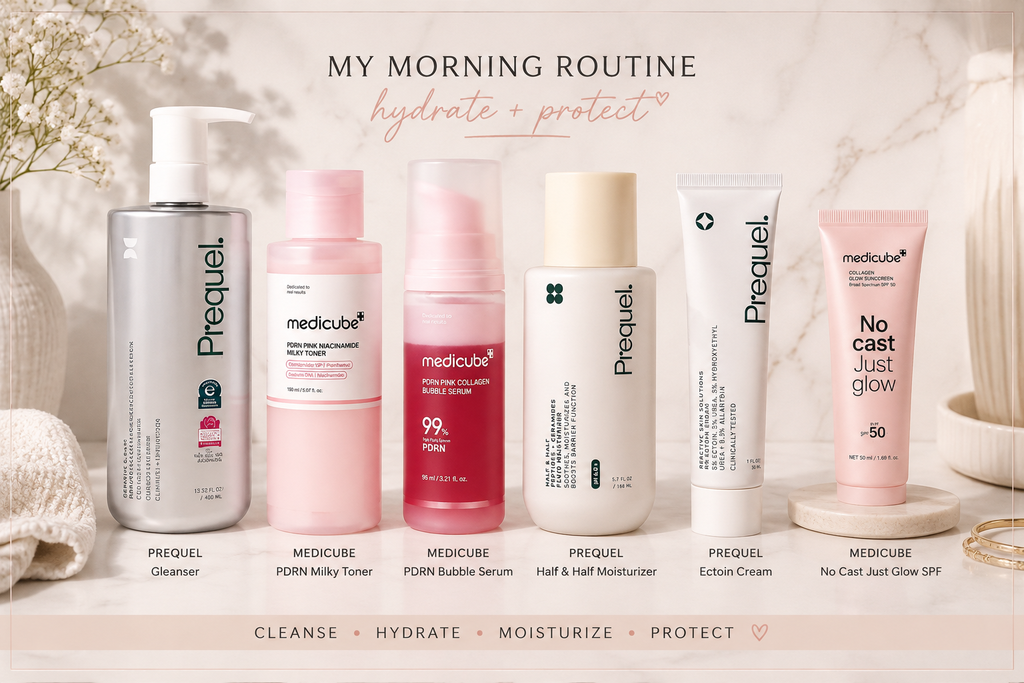
The products currently in my morning skincare routine while using tretinoin.
My morning routine is mostly about hydration, keeping my skin barrier happy and protecting my skin.
Since starting tretinoin, I’ve become much more intentional about not feeling like I need to use every active ingredient I own during the day.
1. Prequel Gleanser
I love starting with the Prequel Gleanser because I don’t feel like I need anything harsh first thing in the morning.
My skin already leans dry, and adding tretinoin into the mix means the last thing I want to do is strip away even more moisture before I’ve even started my day.
It gets my skin clean, but my face doesn’t have that tight, squeaky-clean feeling afterward—which I’ve learned is definitely not what I’m looking for anymore.
Why it’s in my routine: A gentle morning cleanse without making my already-dry skin feel even drier.
2. Medicube PDRN Pink Niacinamide Milky Toner
Next is the Medicube PDRN Pink Niacinamide Milky Toner, and this is where I start layering in hydration.
I personally LOVE milky toners for my dry skin because they give me that little extra step between cleansing and the rest of my skincare.
This one leaves my skin feeling soft and hydrated without feeling like I’ve already piled a ton of product onto my face.
Why it’s in my routine: Lightweight hydration and a nice base for everything I’m putting on afterward.
3. Medicube PDRN Pink Collagen Bubble Serum
Then I use the Medicube PDRN Pink Collagen Bubble Serum.
Besides the fact that the bubble texture makes this one a little more fun to use 😂, I like having a hydrating serum in my morning routine rather than reaching for stronger actives.
I’m already asking a lot of my skin with tretinoin at night.
My morning routine doesn’t need to be another full-blown treatment session.
Why it’s in my routine: An extra layer of hydration without making my morning routine feel overly heavy.
4. Prequel Half & Half Fluid Moisturizer
The Prequel Half & Half Fluid Moisturizer has become a pretty important product in my tretinoin routine because I use it here AND on tretinoin nights as the first layer of my sandwich method.
It’s lightweight enough that I can comfortably use it during the day, but my dry skin still feels moisturized.
I especially like that I can layer other products over it without feeling like I have 37 layers of skincare sitting on my face. 😂
Why it’s in my routine: Everyday barrier-supporting moisture without the heaviness.
5. Prequel 5% Ectoin Cream — If Needed
This isn’t necessarily an everyday morning step.
If I wake up and my skin feels extra dry, tight or irritated—especially after a tretinoin night—I’ll add Prequel 5% Ectoin Cream.
One of the biggest things I’ve changed since my first tretinoin disaster is that I don’t force my skin into the exact same routine every day anymore.
If it feels like it needs more moisture and support?
I give it more.
Why it’s in my routine: This is my “my skin needs a little extra help today” product.
6. Medicube No Cast Just Glow SPF 50
And then we get to what is probably the most important step of my morning routine: sunscreen.
I use Medicube No Cast Just Glow SPF 50 because I actually enjoy wearing it—and I’ve learned that finding an SPF you’ll consistently put on is incredibly important.
I used to think of sunscreen as something you put on when you’re going to be outside all day.
Not anymore.
If I’m putting this much time, effort and money into improving the appearance of fine lines, uneven tone and texture, it makes absolutely no sense for me to ignore daily UV protection.
Tretinoin can also make skin more sensitive to the sun, so SPF has become a non-negotiable part of my morning routine.
Why it’s in my routine: Protecting my skin—and all the work I’m putting into it!
My Tretinoin Skincare Routine: Tretinoin Nights
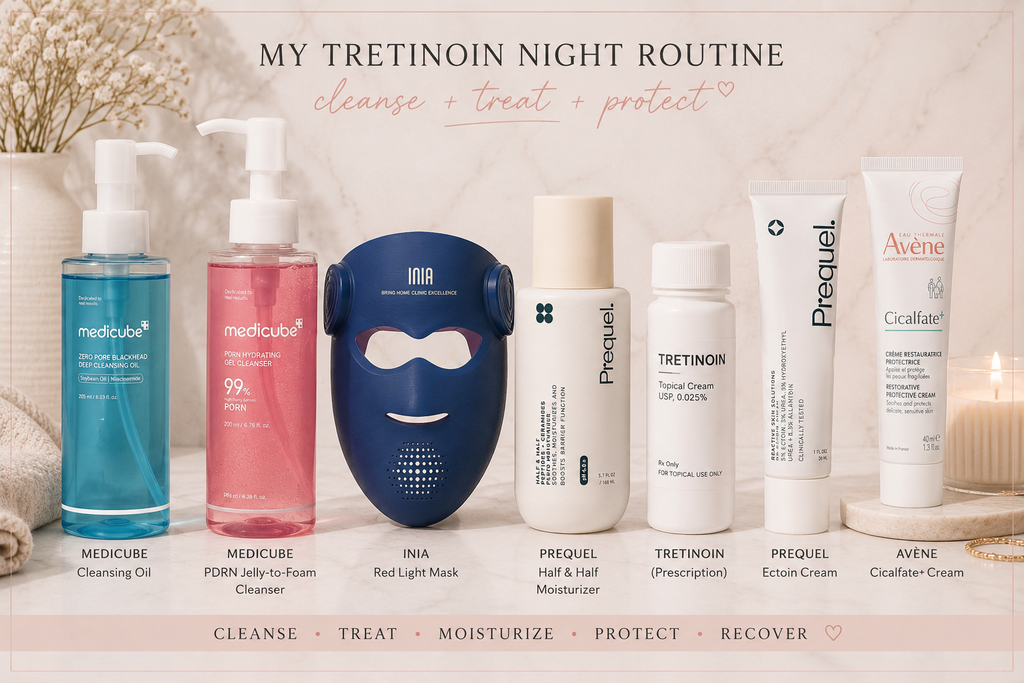
The products currently in my morning skincare routine while using tretinoin.
Tretinoin nights are where I’ve learned that less is more.
I’m not trying to fit every exciting skincare product I own into these nights. 😂
My goal is to cleanse my skin, use my tretinoin as prescribed and give my skin plenty of moisture and barrier support around it.
1. Medicube Zero Pore Blackhead Deep Cleansing Oil
I start with the Medicube Zero Pore Blackhead Deep Cleansing Oil.
This is especially important to me at night because I’ve been wearing sunscreen all day and possibly makeup too.
I want to actually break all of that down before going in with my regular cleanser.
Why it’s in my routine: The first step of my double cleanse to remove makeup, sunscreen and the day’s buildup.
2. Medicube PDRN Hydrating Gel Cleanser
After my cleansing oil, I follow with the Medicube PDRN Hydrating Gel Cleanser.
Again, I’m trying really hard not to strip my skin on tretinoin nights.
I want my skin clean—but I don’t want it feeling tight and dried out before I even apply tretinoin.
Why it’s in my routine: A gentle second cleanse before the rest of my nighttime routine.
3. INIA Red Light Therapy Mask
Once my face is clean, this is when I use my INIA Red Light Therapy Mask.
Red light therapy is something I’ve incorporated separately into my overall skincare routine. I use the mask on clean skin before applying the rest of my products because that’s how it fits best into my routine.
And admittedly…
This is also one of those skincare steps that forces me to sit still for a few minutes, which isn’t necessarily a bad thing. 😂
What Is the Tretinoin Sandwich Method?
Here’s one of the BIG things I changed the second time around.
The tretinoin sandwich method basically means applying moisturizer before and after your tretinoin.
Think:
Moisturizer → Tretinoin → Moisturizer
For my dry, sensitive skin, that moisturizing buffer has made using tretinoin much more manageable.
4. Prequel Half & Half — First Layer of My Sandwich
I apply a layer of Prequel Half & Half Fluid Moisturizer before my tretinoin.
For me, buffering tretinoin with moisturizer has been much easier to tolerate than my original strategy of basically throwing tretinoin on there and hoping for the best.
Spoiler:
That strategy did not go well. 😂
Then I make sure my skin is completely dry before moving on.
5. Prescription Tretinoin
Once my skin is dry, I apply my prescription tretinoin according to my doctor’s directions.
This is also where I remind myself:
MORE IS NOT BETTER.
I use the amount prescribed to me and don’t add extra thinking I’m going to speed up the process.
My skin has already taught me exactly what it thinks about that idea.
6. Prequel 5% Ectoin Cream
I personally wait around 20–30 minutes after applying my tretinoin before moving on, and then I apply Prequel 5% Ectoin Cream.
This becomes the second moisturizing layer of my sandwich.
I especially like having something richer here because dryness and irritation were such big issues for me the first time around.
Why it’s in my routine: The second moisturizing layer of my sandwich and extra support for my dry skin.
7. Avène Cicalfate+ Restorative Protective Cream
Most tretinoin nights, I finish everything off with Avène Cicalfate+.
And when I say finish…
I mean I usually put this on THICK. 😂
Almost like a sleeping mask.
Then I go to bed and leave my skin alone.
If my skin feels really good, I sometimes skip this step.
Again, I’m learning to listen to my skin instead of following a rigid routine simply because that’s what I’m “supposed” to do.
The Night After Tretinoin: Hydration + Barrier Support
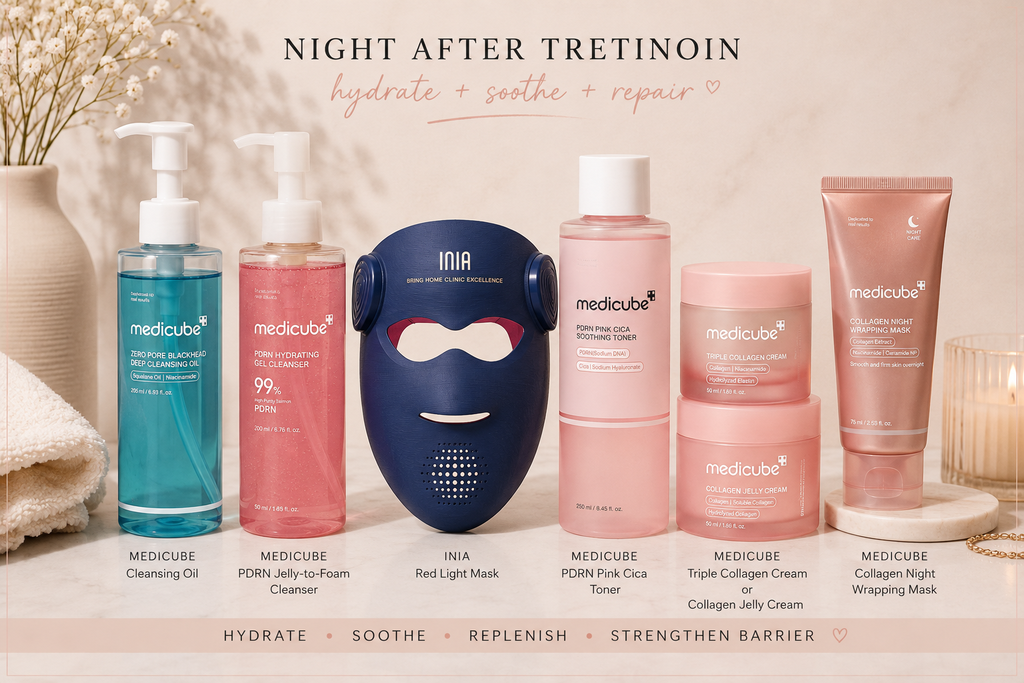
My post-tretinoin night is all about hydration and giving my skin a break.
This might actually be one of the most important changes I’ve made.
The night after tretinoin, I’m not immediately attacking my face with another round of strong actives.
I give it a break.
1. Medicube Cleansing Oil + PDRN Hydrating Gel Cleanser
I still double cleanse because I still need to remove makeup, sunscreen and buildup from the day.
After that, though, my focus changes completely.
2. INIA Red Light Therapy Mask
I’ll use my INIA mask after cleansing and before applying my leave-on skincare.
3. Medicube PDRN Pink Cica Soothing Toner
Then I go in with the Medicube PDRN Pink Cica Soothing Toner.
This is exactly the type of product I want on these nights: something that makes my skin feel hydrated and comfortable rather than adding another aggressive treatment step.
Why it’s in my routine: Hydration and a soothing-feeling step after a tretinoin night.
4. Medicube Triple Collagen Cream OR Collagen Jelly Cream
Depending on how my skin feels, I’ll use either the Medicube Triple Collagen Cream or the Medicube Collagen Jelly Cream.
Not both.
I choose whichever texture I’m feeling that night and how much moisture my skin seems to need.
The Triple Collagen Cream gives me that more traditional creamy moisturizer feel, while the Jelly Cream has that really satisfying gel texture.
Why they’re in my routine: Moisture—and options! I can choose based on what my skin feels like it needs that night.
5. Medicube Collagen Night Wrapping Mask
If I want that extra overnight layer, I’ll finish with the Medicube Collagen Night Wrapping Mask.
This is one of those products that makes a regular Tuesday-night skincare routine feel slightly more exciting. 😂
I use it as my final step and leave it on overnight according to the product directions.
Why it’s in my routine: An optional final moisturizing step when I want to give my skin a little extra TLC.
My Other Non-Tretinoin Nights
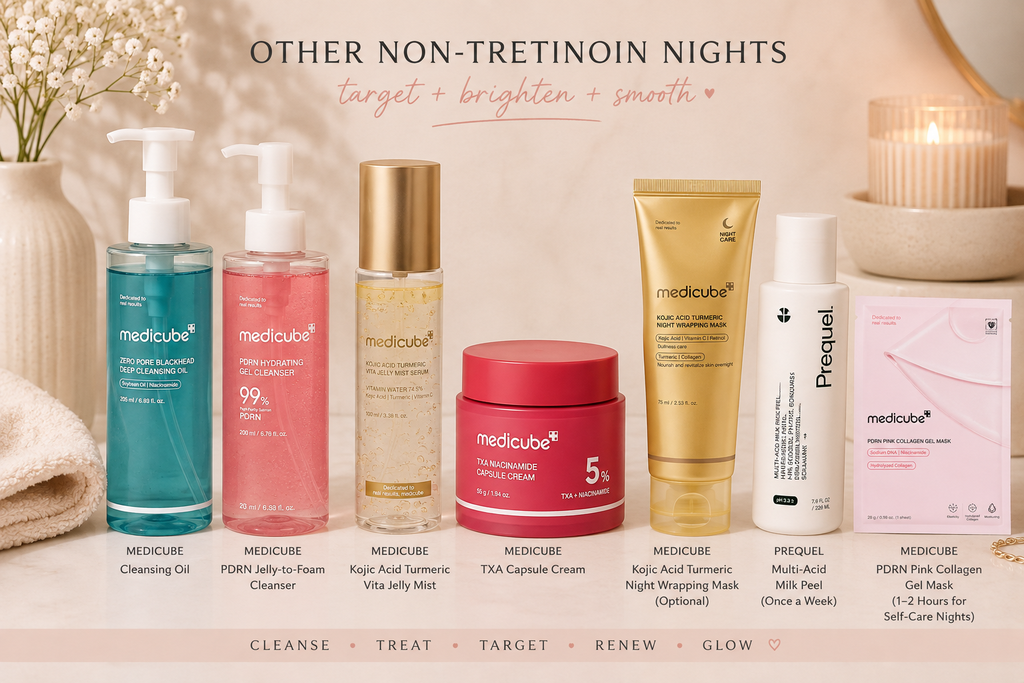
The products I rotate into my routine on other non-tretinoin nights.
Not every night needs to revolve around tretinoin.
On other nights, I have room to use products aimed at some of the other things I’m trying to improve—especially the appearance of uneven tone and dullness.
1. Medicube Cleansing Oil + PDRN Hydrating Gel Cleanser
Same double cleanse.
Honestly, this consistency makes my routine much easier.
I don’t have to reinvent the first two steps every night.
2. Medicube Kojic Acid Turmeric Vita Jelly Mist Serum
Then I use the Medicube Kojic Acid Turmeric Vita Jelly Mist Serum.
I like using this on my non-tret nights because I’m intentionally keeping my tretinoin routine simple.
Rather than throwing every treatment product I own onto my skin at once, I’m giving different products their own place in my weekly routine.
Why it’s in my routine: It’s one of the products I’ve chosen for nights when my focus is the appearance of dullness and uneven skin tone.
3. Medicube TXA Niacinamide Capsule Cream
Next I’ll use the Medicube TXA Niacinamide Capsule Cream.
This is another product I reserve for these non-tret treatment nights instead of trying to cram it into my tretinoin routine.
Why it’s in my routine: It fits with my goal of improving the appearance of uneven tone while still giving my skin moisture.
4. Medicube Kojic Acid Turmeric Night Wrapping Mask — Optional
If I want the whole routine, I’ll finish with the coordinating Kojic Acid Turmeric Night Wrapping Mask.
But this is optional.
Sometimes I’m tired.
Sometimes four skincare steps suddenly feel like 47.
We’re keeping this realistic. 😂
About Once a Week: Prequel Multi-Acid Milk Peel
About once a week—depending on how my skin is feeling—I’ll use the Prequel Multi-Acid Milk Peel on a non-tretinoin night.
I keep my exfoliating acids separate from my tretinoin routine because my skin has already demonstrated that it is perfectly capable of throwing a full-blown tantrum when I overdo it. 😂
And if my skin feels irritated, dry or compromised?
I skip it.
My weekly schedule doesn’t get to overrule my skin anymore.
When I Have Time for a Little Extra Self-Care
And then there’s the Medicube PDRN Pink Collagen Gel Mask.
This isn’t something I’m pretending I have time to do every night. 😂
When I have a little extra time and actually want to turn my skincare routine into some self-care, I’ll put this on and leave it for around 1–2 hours according to the product directions.
It’s one of those steps that’s less about:
“I absolutely need this every Tuesday at 8:17 PM.”
And more:
The kids are settled. I have some time. I’m putting on a face mask. Nobody bother me. 😂
What I Wish I Knew Before Starting Tretinoin
If you’re reading this because you’re thinking about starting tretinoin—or maybe you’ve already started and your skin is currently wondering what on Earth you’ve done to it—these are the things I wish I’d understood from the beginning.
Start slower than you think you need to.
I was so focused on getting results that I forgot my skin needed time to adjust.
Your skin barrier matters more than sticking to a schedule.
Just because tonight was supposed to be a tretinoin night doesn’t mean I have to use it.
You don’t need every active ingredient every night.
This was a BIG one for me.
More skincare isn’t automatically better skincare.
Dry skin needs support—not punishment.
If my skin feels dry or irritated, I focus on hydration.
SPF isn’t optional in my routine anymore.
Especially when I’m putting this much effort into addressing visible signs of aging and uneven tone.
The sandwich method changed the experience for me.
Using moisturizer before and after tretinoin has made it much easier for my dry, sensitive skin to tolerate.
Results take time.
I’m playing the long game now.
I’m not trying to wake up looking 25 next Tuesday. 😂
I want a routine that I can actually stick with.
My Biggest Advice If You’re Just Starting Tretinoin
After my first experience, this is probably the most important thing I can say:
Don’t copy someone else’s tretinoin schedule just because their skin can handle it.
Including mine.
Tretinoin is a prescription medication. The amount, strength and frequency that works for me isn’t necessarily what someone else’s skin needs.
This post isn’t meant to tell you exactly how you should use tretinoin.
It’s meant to show you how I personally built the rest of my skincare routine around it after learning—rather painfully 😂—that my skin needed a much gentler approach.
Talk to your healthcare provider about your prescription.
Follow their directions.
And pay attention to your skin.
After everything I learned the hard way, my tretinoin skincare routine looks completely different than it did when I first started.
Am I Seeing Results Yet?
I’m still very much in the process.
And I actually want to keep this section in the post because I don’t want this to become one of those:
“I used this product and suddenly I have completely different skin!”
articles.
That’s not my experience.
I’m using tretinoin because I’m interested in the long-term results, and I’m still figuring out what routine works best for my skin along the way.
So instead of declaring some miraculous transformation, I’m going to keep updating this post as I continue using it.
What changes?
What products stay?
What products leave?
Does my tretinoin frequency eventually increase?
And—most importantly—how does my skin look and feel several months from now?
I’ll come back and update it.
Frequently Asked Questions About My Tretinoin Routine
How often do I use tretinoin?
Right now, I generally use my prescription tretinoin around 2–3 nights per week, depending on how my skin feels. I follow my prescriber’s directions and adjust my surrounding skincare routine based on how my skin is tolerating it.
What is the tretinoin sandwich method?
The sandwich method means using moisturizer before and after tretinoin:
Moisturizer → Tretinoin → Moisturizer
I personally prefer this method because my skin is dry and sensitive, and I’ve found the additional moisturizing layers make my routine more comfortable.
Do I exfoliate while using tretinoin?
I do use an exfoliating acid product occasionally, but I keep it on a separate non-tretinoin night and skip it completely if my skin feels irritated or overly dry.
What do I use the night after tretinoin?
I intentionally make the night after tretinoin a hydration and barrier-support night rather than immediately following it with another strong treatment routine.
Do I use all of these products every night?
Definitely not!
That’s one of the biggest points of this entire routine.
My products are divided between morning, tretinoin nights, post-tretinoin recovery nights and other non-tret nights. I’m rotating products—not layering everything you see in this article onto my face at once. 😂
Shop My Tretinoin-Friendly Skincare Routine
If you’re wondering where everything is after reading approximately 900 skincare product names 😂, here’s the easy version.
Cleansers
Prequel Gleanser
Medicube Zero Pore Blackhead Deep Cleansing Oil
Medicube PDRN Hydrating Gel Cleanser
Hydration + Barrier Support
Medicube PDRN Pink Niacinamide Milky Toner
Medicube PDRN Pink Cica Soothing Toner
Prequel Half & Half Fluid Moisturizer
Prequel 5% Ectoin Cream
Avène Cicalfate+
Serums + Treatments
Medicube PDRN Pink Collagen Bubble Serum
Medicube Kojic Acid Turmeric Vita Jelly Mist Serum
Medicube TXA Niacinamide Capsule Cream
Prequel Multi-Acid Milk Peel
Masks
Medicube Collagen Night Wrapping Mask
Medicube Kojic Acid Turmeric Night Wrapping Mask
Medicube PDRN Pink Collagen Gel Mask
Sun Protection
Medicube No Cast Just Glow SPF 50
Skincare Device
Some links above may be affiliate links. If you purchase through one of my links, I may earn a commission at no additional cost to you. Thank you for supporting Lindsey, Lately!
The Bottom Line
If I could go back and tell myself one thing before starting tretinoin, it would be this:
You do not need to destroy your skin to improve it.
The biggest thing I’ve learned from building my tretinoin skincare routine is that more isn’t always better.
I started tretinoin because I wanted smoother, healthier-looking skin—not because I wanted to spend weeks repairing a damaged skin barrier. 😂
Starting over with a slower approach, simplifying my tretinoin nights and giving my skin dedicated recovery nights has made the experience completely different for me.
I’m still figuring out exactly what my skin loves, and I’m sure this routine will continue evolving.
But that’s also why I wanted to document it here.
I don’t want this blog to only show you a perfectly curated list of products.
I want to share what I’m actually using, why I’m using it, what’s working for me—and the mistakes I make along the way.
Because apparently sometimes learning what not to do is just as useful. 😂
If dry skin is something you struggle with too, you can also check out my Dry Skin Skincare Routine for more of the products I use to keep my skin hydrated.
And if you want to see more of the beauty and skincare products I’m actually using:
Want More Real-Life Favorites?
Medical Disclaimer: This post shares my personal experience and skincare routine and is for informational purposes only. Tretinoin is a prescription medication and may not be appropriate for everyone. Talk with your healthcare provider about whether tretinoin is appropriate for you and follow the directions provided with your prescription.